Modern mobile machines contain far more electronics than ever before. A single construction machine, agricultural vehicle, sanitation truck, or mining vehicle may include dozens of sensors, controllers, displays, valves, motors, and safety systems that must communicate with each other reliably.
Without an efficient communication network, the wiring harness quickly becomes complex, expensive, and difficult to maintain.
This is where the CAN bus plays a critical role.
While CAN bus technology was originally developed for automotive applications, it is now widely used in construction equipment, agricultural machinery, material handling vehicles, sanitation trucks, mining equipment, and many other off-highway machines.
In modern mobile machinery, CAN bus is not simply a communication protocol. It serves as the backbone of the entire machine control system, connecting controllers, HMI displays, distributed I/O modules, sensors, and actuators through a reliable network.
CAN stands for Controller Area Network.
It is a communication network that allows multiple electronic devices to exchange data over a shared two-wire communication line.
Instead of connecting every sensor and actuator directly to a controller through dedicated wires, CAN bus allows all devices to communicate through a common network.
A typical CAN network may include:
Mobile machinery controller
HMI display
Distributed I/O modules
Pressure sensors
Temperature sensors
Hydraulic valves
Electric motors
Safety systems
GPS modules
Telematics devices
All devices connected to the CAN network can send and receive information efficiently without requiring a dedicated communication line for each connection.
The primary reason is simple:
It dramatically reduces wiring complexity while improving communication reliability.
As machine functions increase, traditional point-to-point wiring becomes difficult to manage.
Imagine a wheel loader with:
Engine monitoring
Hydraulic control
Operator display
Camera system
Lighting system
Remote diagnostics
Safety sensors
Using traditional wiring, each device would require separate signal lines.
The result is:
Large wiring harnesses
Increased installation cost
Higher failure rates
Difficult troubleshooting
Poor scalability
A CAN-based architecture allows all devices to communicate through a common network, significantly reducing wiring requirements.
Benefits include:
Reduced wiring length
Lower installation cost
Easier machine expansion
Improved diagnostics
Better system reliability
Faster maintenance
Construction machines operate in harsh environments where vibration, dust, moisture, and temperature extremes are common.
CAN bus is widely used in:
A CAN network may connect:
Main controller
Engine ECU
Hydraulic control system
Operator display
Joystick controls
Pressure sensors
The controller continuously exchanges data with these devices to optimize machine performance.
CAN bus enables communication between:
Engine management system
Transmission controller
Hydraulic controllers
Display systems
Safety modules
Operators can monitor machine status through a centralized HMI display.

Boom lifts and scissor lifts often use CAN bus to coordinate:
Drive systems
Lift functions
Safety interlocks
Operator interfaces
This architecture simplifies wiring throughout the machine structure.

Modern agricultural equipment relies heavily on electronic control systems.
Examples include:
CAN bus allows communication between:
Engine controller
Transmission controller
Instrument cluster
GPS guidance system
ISOBUS equipment
Electronic planting systems require:
Precise seed monitoring
Row control
Variable rate application
Real-time diagnostics
CAN communication enables data sharing between multiple subsystems.
Harvesters may contain dozens of sensors monitoring:
Grain flow
Engine parameters
Hydraulic systems
Fuel consumption
CAN bus allows all information to be displayed through a single operator interface.
Sanitation vehicles often require coordination between multiple hydraulic and electrical systems.
Typical functions include:
Bin lifting
Compaction control
Hopper monitoring
Rear camera systems
Vehicle diagnostics
A CAN-based control architecture simplifies integration of these functions.
For example, a sanitation truck controller can receive information from position sensors and hydraulic pressure sensors while simultaneously sending commands to hydraulic valves and updating the HMI display.
Forklifts, reach stackers, and container handling equipment rely on CAN networks for machine control.
Common applications include:
Drive motor control
Steering systems
Mast control
Load monitoring
Operator displays
Because these machines often operate continuously in demanding environments, reliable communication is essential.
CAN bus provides robust performance even in electrically noisy environments.
One of the most important uses of CAN bus in mobile machinery is system integration.
A typical machine architecture may include:
The controller acts as the brain of the machine.
Responsibilities include:
Logic processing
Sensor monitoring
Hydraulic control
Safety management

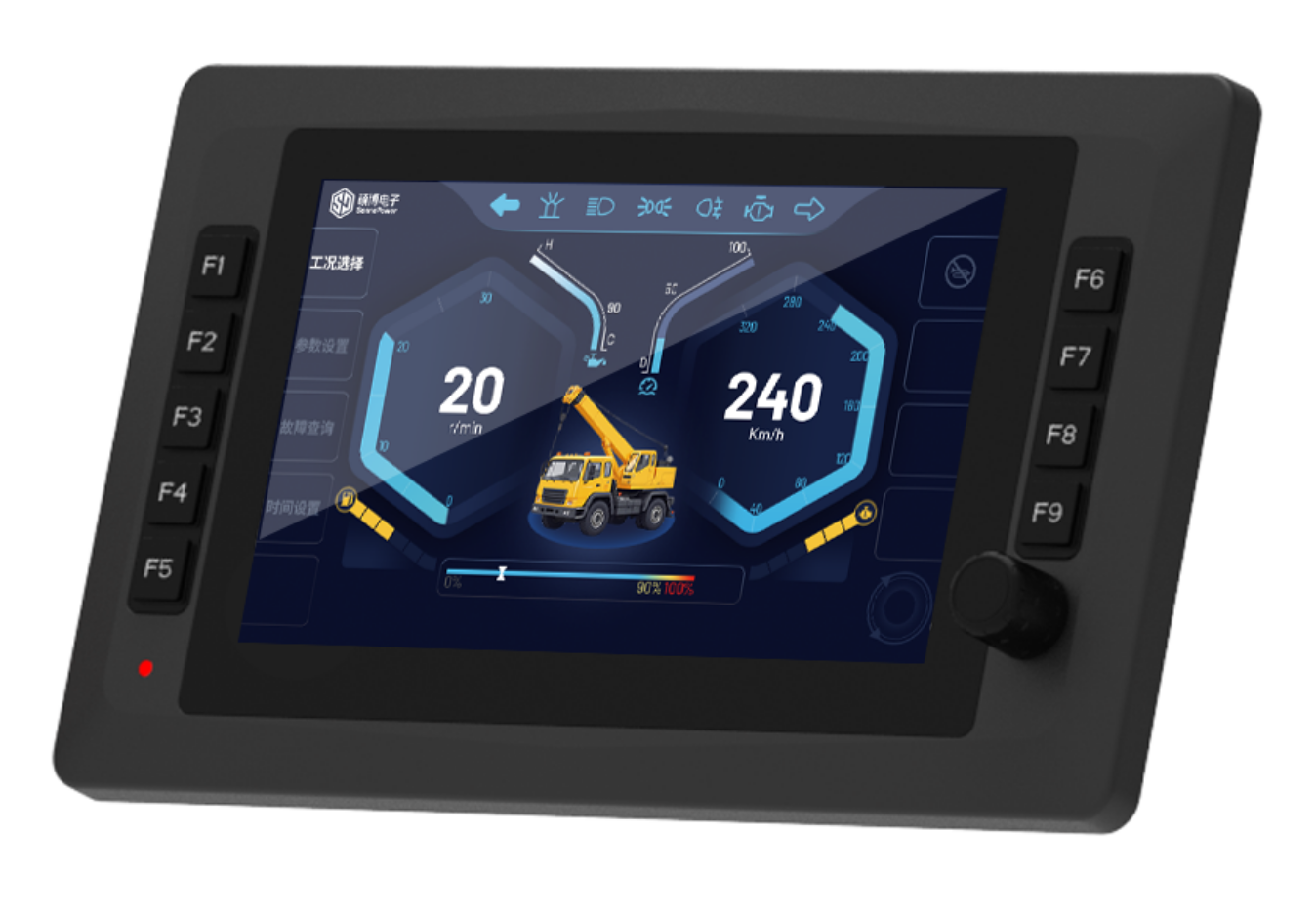
The display provides:
Machine status
Diagnostic information
Operating parameters
Alarm notifications
Instead of using dozens of dedicated wires, the display communicates through CAN bus.
Distributed I/O modules collect signals from sensors and switches located throughout the machine.
Benefits include:
Reduced wiring harness length
Easier installation
Better modularity
Simplified maintenance
The I/O modules communicate with the main controller through the CAN network.

Traditional machine architectures often rely on centralized wiring.
As machine complexity increases, this approach becomes inefficient.
CAN bus allows multiple devices to share a communication network.
Fewer wires mean:
Lower weight
Reduced material costs
Faster assembly
Adding a new sensor or module often requires only a CAN connection rather than an entirely new wiring harness.
CAN networks support advanced diagnostic capabilities.
Controllers can identify:
Communication failures
Sensor faults
Network errors
Module failures
CAN uses differential signaling through CAN-H and CAN-L lines.
This improves resistance to:
Electrical noise
Electromagnetic interference
Harsh industrial environments
Not all CAN systems operate the same way.
Different applications use different higher-level protocols.
Common in:
Industrial automation
Mobile machinery
Distributed I/O systems
Advantages:
Standardized device profiles
Easy integration
Flexible network design
Widely used in:
Trucks
Agricultural equipment
Construction machinery
Advantages:
Standardized communication
Strong industry adoption
Interoperability between devices
Some OEMs use proprietary CAN protocols tailored to their machine requirements.
These protocols may provide unique functions not covered by CANopen or J1939.Common CAN Bus Design Mistakes
Despite its advantages, CAN bus systems can experience problems if designed incorrectly.
A CAN network typically requires 120-ohm termination resistors at both ends of the bus.
Improper termination can cause communication errors.
Long cable runs may affect signal quality if network design rules are ignored.
Grounding issues can introduce communication instability.
Mobile machinery operates under:
Vibration
Moisture
Dust
Temperature extremes
Components should be designed for rugged environments.
Advanced diagnostics simplify troubleshooting and reduce machine downtime.
When selecting CAN-enabled devices, OEMs should consider more than protocol support.
Important factors include:
Evaluate:
I/O capacity
CAN channels
Processing power
Safety requirements
Consider:
Screen brightness
Touch performance
Environmental protection
Camera integration
Look for:
Expandable architecture
Diagnostic functions
Rugged enclosure design
Mobile machinery often requires:
IP67 protection
Vibration resistance
Wide operating temperature range
These factors are often more important than protocol support alone.
CAN bus is used to connect controllers, displays, sensors, actuators, and distributed I/O modules through a reliable communication network.
While it was originally developed for automotive applications, CAN bus has become the foundation of modern mobile machinery control systems.
From excavators and wheel loaders to tractors, sanitation vehicles, forklifts, and mining equipment, CAN bus helps manufacturers reduce wiring complexity, improve reliability, simplify diagnostics, and create scalable machine architectures.
For OEMs developing modern off-highway equipment, understanding how CAN bus integrates controllers, HMI displays, and distributed I/O modules is essential for building reliable and efficient machine control systems.
 English