Many machine manufacturers focus only on the total number of I/O channels. However, successful controller selection requires a deeper understanding of signal types, expansion requirements, and future upgrades.
This guide explains a practical method for calculating I/O requirements for mobile machinery applications such as boom lifts, cranes, agricultural sprayers, municipal vehicles, and other off-highway equipment.
Incorrect I/O planning can create problems throughout the machine's lifecycle.
If the controller is undersized, additional sensors, valves, or optional functions may require a controller replacement later. This increases engineering costs and may delay product development.
On the other hand, selecting a controller with far more I/O than necessary can increase system costs without delivering additional value.
A well-planned I/O architecture helps:
Reduce hardware costs
Simplify wiring design
Support future upgrades
Improve system reliability
Minimize redesign work
The goal is not to buy the largest controller available. The goal is to choose the right controller for your application.
Before calculating requirements, it is important to understand the most common signal types used in mobile machinery.
Digital inputs receive simple ON/OFF signals from switches and sensors.
Typical examples include:
Emergency stop buttons
Limit switches
Seat switches
Door switches
Parking brake switches
Proximity sensors
Each device typically requires one digital input channel.
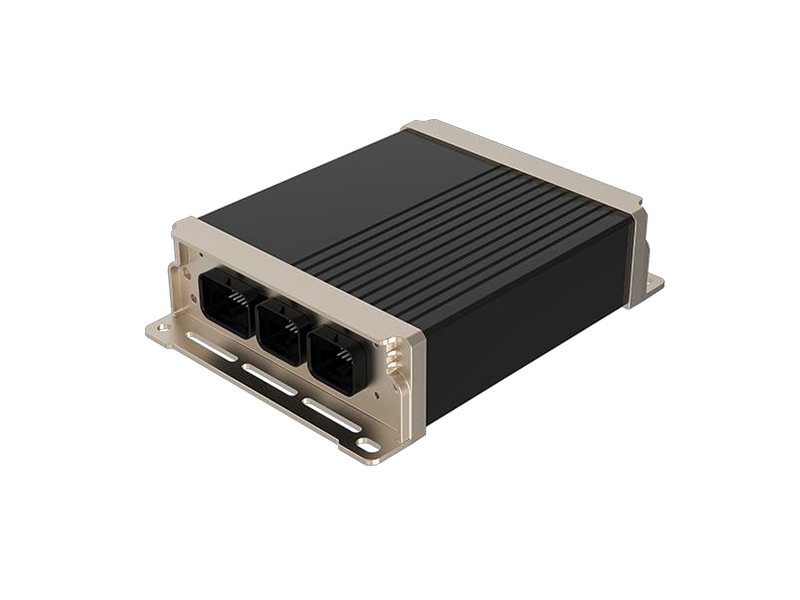
Digital outputs control devices that operate in an ON/OFF state.
Examples include:
Warning lights
Relays
Buzzers
Cooling fans
Solenoid valves
Each controlled device generally requires one digital output channel.
Analog inputs receive continuously changing signals from sensors.
Common examples include:
Pressure sensors
Temperature sensors
Fuel level sensors
Position sensors
Load measurement sensors
Unlike digital signals, analog signals provide measurement values rather than simple ON/OFF information.
PWM (Pulse Width Modulation) outputs are commonly used in hydraulic systems.
Applications include:
Proportional hydraulic valves
Fan speed control
Motor speed control
PWM outputs should not be treated as ordinary digital outputs because they require dedicated control capabilities.
A structured approach makes controller selection much easier.
Create a complete list of every sensor used on the machine.
For example:
Pressure sensors
Temperature sensors
Limit switches
Position sensors
Safety switches
Record the quantity of each sensor.
Next, identify every device controlled by the controller.
Examples include:
Hydraulic valves
Relays
Warning lights
Fans
Solenoids
Again, record the quantity of each device.
Group each device according to its required signal type.
Typical categories include:
Digital Inputs (DI)
Digital Outputs (DO)
Analog Inputs (AI)
PWM Outputs
This step often reveals that a machine requires fewer total channels than expected but more specialized outputs than originally planned.
Future upgrades are common in mobile machinery.
Additional functions may include:
New sensors
Additional hydraulic functions
Optional equipment packages
Regulatory requirements
For this reason, spare capacity should always be included in the design.
Recommended spare capacity:
| Machine Type | Recommended Spare Capacity |
|---|---|
| Small Machines | 20% |
| Medium Machines | 25% |
| Complex Machines | 30% |
The following example demonstrates a simplified boom lift controller calculation.
| Signal Type | Quantity |
|---|---|
| Digital Inputs | 18 |
| Digital Outputs | 12 |
| Analog Inputs | 6 |
| PWM Outputs | 8 |
Subtotal:
44 channels
Adding 25% spare capacity:
44 × 1.25 = 55 channels
In this case, a controller offering approximately 55–60 usable channels would provide sufficient capacity for future expansion.
The final selection should also consider communication interfaces, environmental protection ratings, and software requirements.
As machine complexity increases, simply choosing a larger controller is not always the best solution.
Remote I/O modules can provide additional channels closer to sensors and actuators throughout the machine.
Benefits include:
Reduced wiring length
Lower installation costs
Easier maintenance
Improved scalability
Simplified machine architecture
For large machines such as cranes, agricultural sprayers, and airport ground support equipment, distributed I/O architectures often provide a more efficient solution than centralized wiring.
When CAN-based communication is available, remote I/O modules can significantly reduce harness complexity while maintaining reliable control performance.
Determining the correct number of I/O channels is one of the most important steps in mobile machinery controller selection.
Rather than focusing only on the total channel count, engineers should evaluate signal types, future expansion requirements, and machine architecture.
A structured calculation process helps ensure that the selected controller supports both current functions and future upgrades without unnecessary cost.
By understanding digital inputs, digital outputs, analog inputs, PWM outputs, and spare capacity requirements, machine manufacturers can build more reliable and scalable control systems from the start.
List all sensors, switches, valves, relays, and other controlled devices. Then classify them by signal type and add spare capacity for future expansion.
Most mobile machinery applications benefit from 20% to 30% spare capacity, depending on machine complexity and future upgrade plans.
Yes. PWM outputs provide variable control signals and are commonly used for proportional hydraulic valves and motor speed control.
Remote I/O modules are useful when machine size, wiring complexity, or future expansion requirements make centralized wiring inefficient.
Additional sensors or functions may require controller replacement, system redesign, or the addition of expansion I/O modules.
 English